
UI vs UX Design: Understanding the Key Differences in 2026
UI and UX get used interchangeably so often that even experienced founders often confuse the two. The terms sound similar. They’re closely connected. They’re often handled by the same team. But they’re fundamentally different disciplines — and understanding the difference can transform how you build digital products.
In this guide, we’ll break down UI vs UX clearly, explain how they work together, and show why neglecting either one quietly destroys conversion rates.
What Is UX Design?
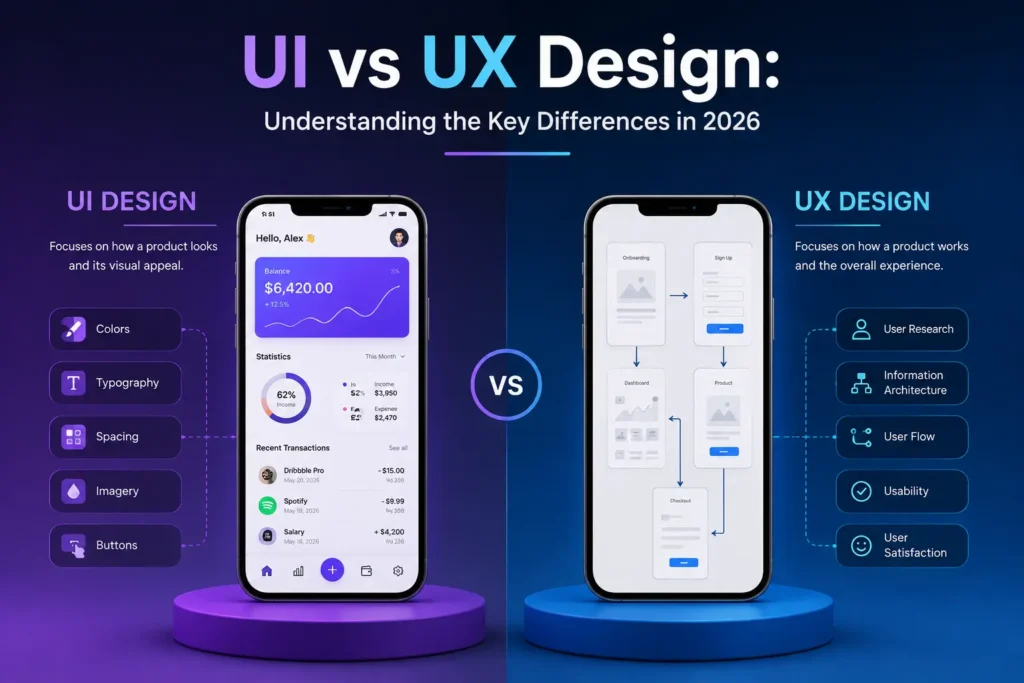
UX — User Experience — design is about how a product feels to use. It’s the strategic, research-led discipline focused on understanding user needs, mapping journeys, removing friction, and ensuring people can achieve their goals as efficiently as possible.
Nielsen Norman Group, the world’s leading UX research firm, defines UX as encompassing every aspect of the user’s interaction with a company, its services, and its products.
What Is UI Design?
UI — User Interface — design is about how a product looks and how each element behaves visually. It includes typography, colour, spacing, buttons, icons, animations, and the overall visual hierarchy.
If UX is the architecture of the experience, UI is the interior design that makes it inviting and beautiful.
The Key Differences
UX is broader and earlier in the process. UI is more visual and comes once experience structure is defined. UX deals with research, journeys, wireframes, and information architecture. UI deals with visual systems, components, and pixel-level polish.
UX answers: does this make sense? UI answers: does this feel right?
How They Work Together
UI and UX are inseparable in practice. Beautiful UI built on broken UX leads to gorgeous interfaces that frustrate users. Strong UX with weak UI leads to functional but uninspiring products that fail to build emotional connection.
The best digital products excel at both — and that’s exactly the standard we hold ourselves to in our UI/UX design service.
Why Both Matter for Your Business
Strong UI/UX directly drives conversions, retention, and revenue. Research from Forrester has consistently shown that well-designed interfaces can lift conversion rates significantly — often by hundreds of percent. The investment in UI/UX is rarely a cost; it’s one of the highest-ROI investments any digital business can make.
Tools UI/UX Designers Use
Designers in 2026 typically work in Figma, supported by tools like Adobe XD, Sketch, Maze for usability testing, and Hotjar for behavioural research.
Frequently Asked Questions
Can one person do both UI and UX?
Yes — many designers do both, especially in smaller teams.
Which is more important?
Both. Skipping either leads to weaker products.
Where does branding fit in?
Branding sits closer to UI but informs UX through tone and emotional positioning.
Final Thoughts
UI and UX aren’t competitors — they’re partners. If you’d like world-class design support for your next project, book a free consultation with our team.