
On-Page vs Off-Page SEO: What’s the Difference and Why Both Matter
If you’ve ever felt overwhelmed by SEO advice, you’re not alone. The field is full of jargon, conflicting opinions, and constant updates. But almost every SEO tactic eventually falls into one of two clear categories: on-page or off-page. Understanding the difference — and how they work together — makes everything else simpler.
In this guide, we’ll break down both, explain why both matter, and show you how to balance them for sustainable growth.
What Is On-Page SEO?
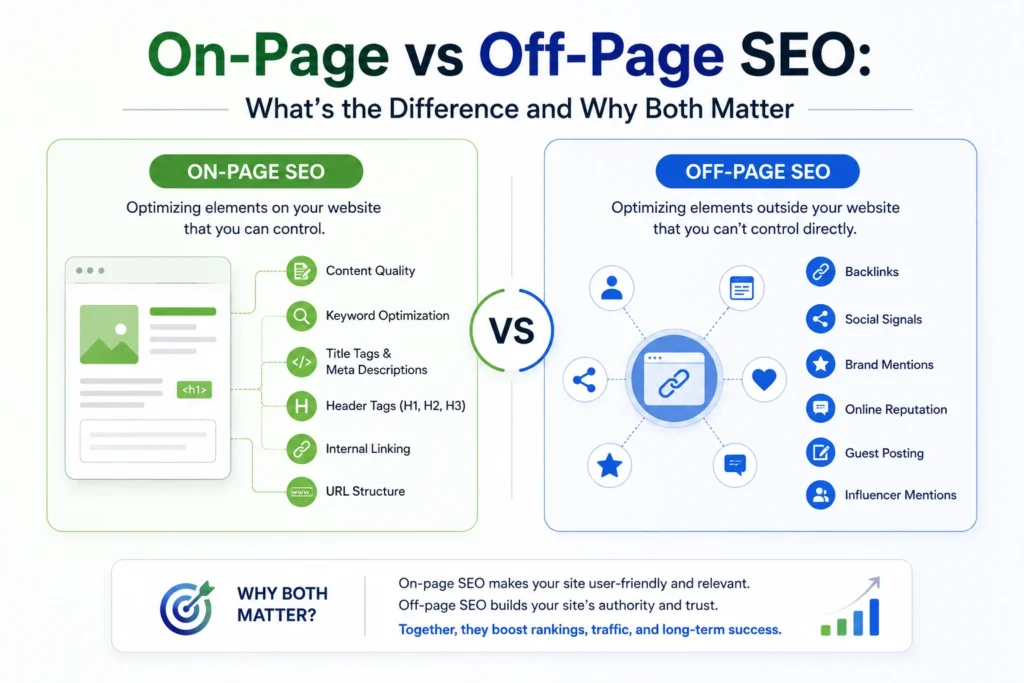
On-page SEO covers everything you control directly on your website. This includes content, headings, internal links, page speed, metadata, image optimisation, and structured data. If it lives on your pages, it’s on-page.
The goal of on-page SEO is to make every page genuinely useful, well-structured, and easy for both users and search engines to understand. Google’s helpful content guidelines describe exactly the kind of pages that succeed long-term.
What Is Off-Page SEO?
Off-page SEO covers everything that happens beyond your website — particularly backlinks from other websites, brand mentions, online reviews, and overall authority signals. According to Moz’s research, high-quality backlinks remain one of Google’s strongest ranking factors.
The goal of off-page SEO is to build credibility and authority that the wider web confirms.
Why On-Page SEO Matters
You can’t rank without strong on-page foundations. Even the best backlinks won’t save a slow, confusing, poorly written website. Every page should target a clear keyword, answer the searcher’s question fully, link to related content, and load fast on every device. We integrate strong on-page SEO into every website we build.
Why Off-Page SEO Matters
Off-page SEO is how Google and other search engines verify whether the wider web actually trusts you. Brands cited by reputable sources, mentioned in industry publications, and linked from authoritative websites consistently outrank brands without external validation.
How They Work Together
On-page SEO is your foundation. Off-page SEO is your reputation. Skip on-page and your foundations are weak — no amount of links will save you. Skip off-page and your strong content sits unnoticed. Both must run in parallel.
For example, when we run SEO optimisation for a client, we typically begin with on-page audits and improvements, then layer in content strategy and off-page authority building over time.
Practical Balance for Most Businesses
For startups and SMEs, the smart play is roughly 70% on-page in the first six months — building strong content, fixing technical issues, and creating a foundation worth linking to. After that, off-page becomes increasingly important as the site matures.
Frequently Asked Questions
Which is more important?
Both — neither works alone long-term.
Can backlinks rank a weak site?
Rarely, and never sustainably.
Where should beginners start?
Always start on-page. Off-page rewards strong on-page work.
Final Thoughts
On-page and off-page SEO aren’t competitors — they’re partners. If you’d like an expert audit of both, book a free consultation and let’s plan your path to higher rankings.