
How to Calculate and Improve Your Return on Ad Spend (ROAS) in 2026
Every advertising decision eventually comes down to one question: did we make more than we spent? Return on Ad Spend — ROAS — is how performance marketers answer that question. It’s simple in theory, but improving it consistently is where real expertise lives.
In this guide, we’ll walk through how to calculate ROAS, what a good benchmark looks like in 2026, and proven ways to improve it across your campaigns.
What Is ROAS?
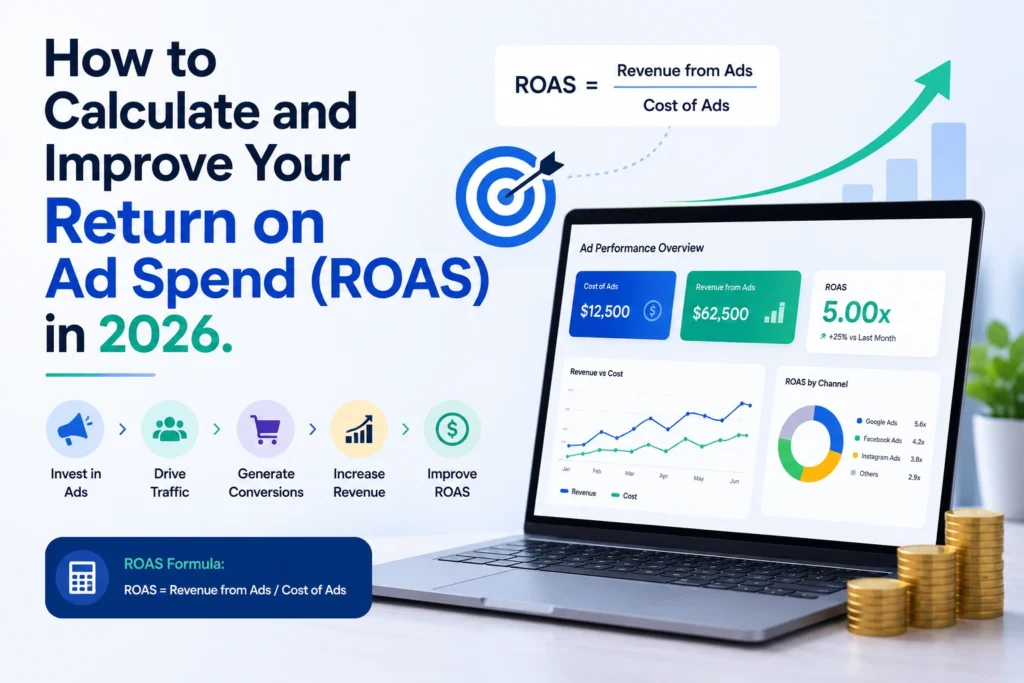
ROAS stands for Return on Ad Spend. It measures how much revenue you generate for every pound spent on advertising. The formula is straightforward:
ROAS = Revenue from Ads ÷ Ad Spend
A ROAS of 4 means every £1 in ads generates £4 in revenue. ROAS is one of the most universally tracked metrics in modern performance marketing — covered extensively in Google’s measurement documentation.
What’s a Good ROAS?
There’s no universal answer — but useful benchmarks exist. E-commerce brands often target ROAS between 3 and 6. SaaS and subscription brands look at long-term ROAS over months. High-margin services can sometimes profit at ROAS of 1.5–2. The right target depends entirely on your margins, customer lifetime value, and growth stage.
Why ROAS Alone Isn’t Enough
ROAS measures revenue, not profit. A campaign with a 5x ROAS that sells low-margin products may lose money, while a 2x ROAS campaign on high-margin services may be exceptional. This is why advanced marketers also track CPA, LTV, contribution margin, and blended ROAS across all channels.
How to Improve ROAS
Improving ROAS is rarely about one big change — it’s about compounding small wins.
Improve Creative. Creative is the single biggest performance lever in 2026. Test new hooks, formats, and angles regularly. Meta’s marketing science research consistently confirms creative drives the majority of variance.
Improve Audience Targeting. Refine your audiences. Move spend toward high-converting segments. Exclude under-performers ruthlessly.
Improve Landing Pages. A great ad that lands on a slow, confusing page wastes budget. High-converting landing pages often lift ROAS by 30–50% with no additional ad spend.
Improve Offer Strength. Sometimes the issue isn’t the campaign — it’s the offer. Bundles, discounts, free shipping, and limited-time incentives can dramatically improve conversion rates.
Improve Attribution and Tracking. Many brands underreport ROAS due to poor tracking. Google Analytics 4, Meta’s Conversions API, and server-side tracking all play a role here.
Improve Funnel Depth. A great ad campaign without strong email follow-up, retargeting, and retention sequences leaves money on the table. Pairing performance marketing with SEO, social media, and email creates a stronger overall ROI.
Frequently Asked Questions
Is higher ROAS always better?
Not necessarily. Very high ROAS sometimes means underspending. Profitable scaling is the real goal.
Should I optimise for ROAS or CPA?
Both — they tell complementary stories.
Why is my ROAS dropping?
Common reasons: creative fatigue, audience saturation, tracking gaps, or seasonal shifts.
Final Thoughts
Improving ROAS is the closest thing performance marketing has to a north star. If you’d like expert help maximising yours, book a free consultation and let’s review your campaigns together.