
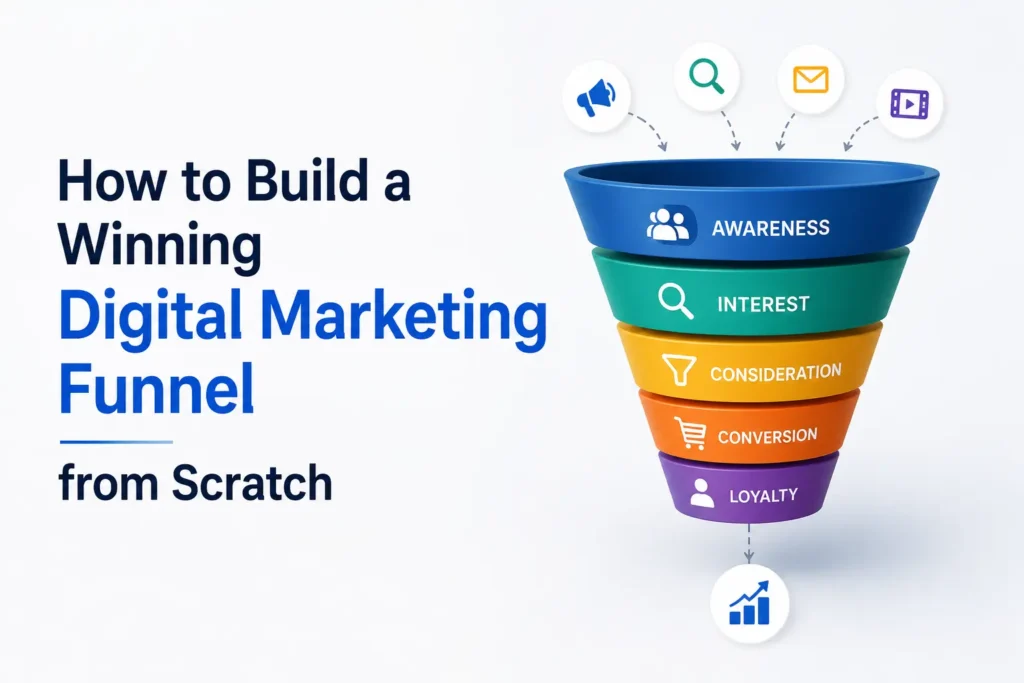
How to Build a Winning Digital Marketing Funnel from Scratch
Most businesses don’t have a marketing problem. They have a funnel problem. Traffic comes in, but very little of it converts. Leads land in your CRM but never become customers. Customers buy once and never return. A well-built digital marketing funnel solves all three problems by guiding the right people, through the right journey, at the right time.
In this guide, we’ll walk you through how to build a complete funnel from scratch — even if you’re starting with limited budget or resources.
What Is a Digital Marketing Funnel?
A digital marketing funnel is a structured journey that takes a stranger and turns them, step by step, into a paying customer — and ideally, a loyal advocate. It usually includes four core stages: awareness, engagement, conversion, and retention. Frameworks like the AIDA model — Attention, Interest, Desire, Action — have shaped marketing for decades, and modern variations are well documented by sources like HubSpot’s flywheel model.
Stage 1: Awareness
This is where strangers first discover you. Your goal is visibility, not selling. Strong awareness channels in 2026 include SEO content, short-form video, paid social, and PR mentions. The best content here answers real questions your audience already asks. This is also where strong SEO optimisation starts paying off.
Stage 2: Engagement
Once people know you exist, they need a reason to keep paying attention. Engagement is built through useful content, helpful emails, active social communities, and a website that immediately demonstrates value. This is where UI/UX design becomes critical — confusing websites lose engagement instantly.
Stage 3: Conversion
Conversion is where strategy meets execution. Your visitors need clear, compelling reasons to take action — whether that’s a purchase, a booking, or a form submission. High-converting landing pages typically share four traits: a single goal, a strong headline, social proof, and friction-free design. According to Nielsen Norman Group, even small UX improvements can produce significant lifts in conversion rates.
Stage 4: Retention
Most businesses stop at conversion — and lose huge amounts of revenue as a result. Existing customers are far cheaper to sell to than new ones. Email automation, loyalty programmes, exceptional support, and ongoing content keep customers engaged long after the first purchase.
Tools That Power Modern Funnels
Tools like HubSpot CRM, Mailchimp, and Google Analytics 4 help track and automate every stage. But tools without strategy create more noise, not more growth. The strategy must come first.
A Simple Funnel Anyone Can Build
A great starter funnel looks like this: SEO blog post → email opt-in with a free resource → automated nurture sequence → strong landing page → checkout or booking → post-purchase email series. This simple structure powers the majority of high-performing digital businesses.
Frequently Asked Questions
How long does it take to build a marketing funnel?
A basic funnel can launch in 2–4 weeks. Optimising it is ongoing work.
Do I need expensive software?
Not initially. Most funnels can launch with affordable, beginner-friendly tools.
What’s the most common mistake?
Skipping the awareness stage and trying to sell directly to cold traffic.
Final Thoughts
A great funnel turns marketing from a guessing game into a predictable growth engine. If you’d like help designing one for your business, book a free consultation with our team.