
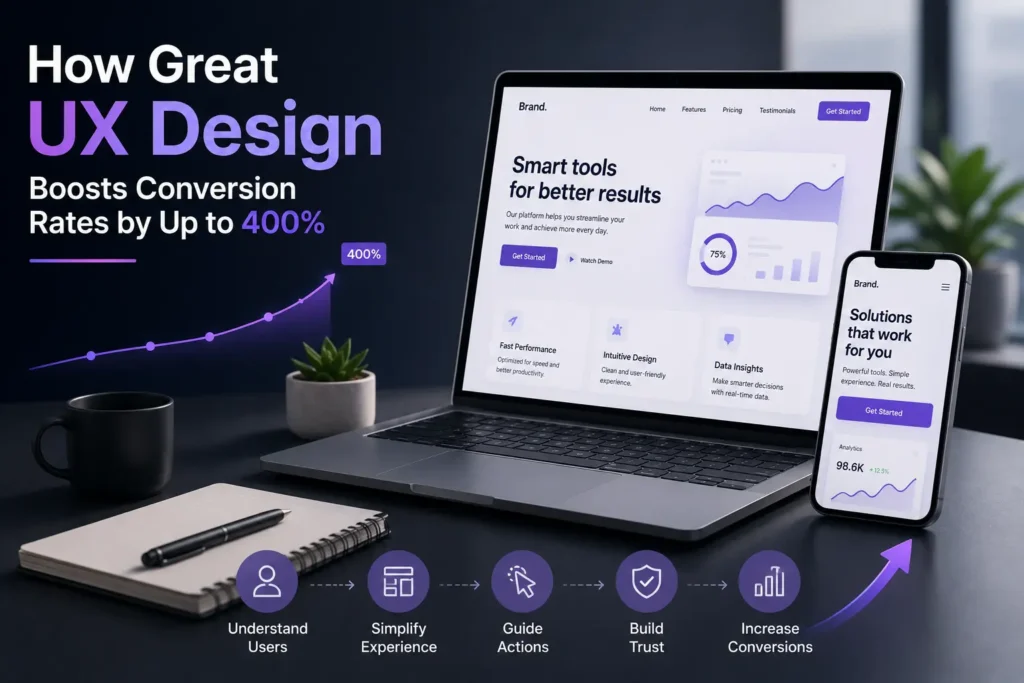
How Great UX Design Boosts Conversion Rates by Up to 400%
Most businesses obsess over traffic. Smart businesses obsess over conversion. The reason is simple — doubling traffic doubles your costs, but doubling your conversion rate doubles your revenue without spending another pound on ads. And the single biggest lever for conversion that most teams underuse is great UX design.
In this guide, we’ll explore why UX has such a profound impact on conversion — and how you can apply it.
Why UX and Conversion Are Deeply Connected
Conversion is fundamentally about reducing friction between intention and action. Every confusing button, slow page, unclear headline, or unnecessary form field stops users from converting. Great UX systematically removes those barriers.
Multiple research studies — including those by Forrester Research — have shown that strong UX design can lift conversion rates dramatically, sometimes by hundreds of percent.
What Great UX Actually Looks Like
Great UX is rarely about flashy design. It’s about clarity, hierarchy, speed, accessibility, and trust. The user always knows where they are, what to do next, and why it matters. The best examples appear so simple that they look obvious in hindsight.
The Top UX Improvements That Lift Conversion
Clearer Value Proposition. A confused visitor never converts. The first thing every page must answer is: what is this and why should I care?
Faster Load Speed. Even a one-second delay can drop conversions significantly. Google’s web performance research consistently confirms this.
Stronger Calls to Action. Specific, benefit-led CTAs almost always outperform generic ones. “Book Free Strategy Call” outperforms “Submit”.
Reduced Form Friction. Every unnecessary form field reduces completion rates. Ask only for what you genuinely need.
Improved Mobile Experience. With most traffic on mobile, weak mobile UX silently destroys conversion.
Trust Signals Everywhere. Reviews, testimonials, certifications, and clear contact information all improve conversion. According to Baymard Institute research, trust friction is one of the top reasons users abandon checkouts.
Why Beautiful Designs Sometimes Convert Worse
Visually impressive designs occasionally hurt conversion. Heavy animations slow pages. Custom interfaces confuse users. Hidden navigation buries primary actions. A striking design isn’t worth much if it gets in the way of the user’s goal.
This is exactly why we approach UI/UX design and landing pages with conversion as a non-negotiable design constraint, not an afterthought.
How to Improve UX Systematically
Use real data, not opinions. Tools like Hotjar, VWO, and Optimizely reveal where users struggle. Combine that with usability testing, A/B testing, and iterative redesigns. Over time, small UX improvements compound into significant revenue lifts.
Frequently Asked Questions
How quickly can UX improvements impact conversion?
Often within days of going live.
Do I need a full redesign to improve UX?
No. Many wins come from targeted improvements to high-traffic pages.
How much should I invest in UX?
Treat it as a revenue-generating investment, not a cost.
Final Thoughts
Great UX is the most underrated revenue lever in modern business. If you’d like an expert audit of your website’s UX, book a free consultation and we’ll show you exactly where you’re leaving money on the table.