

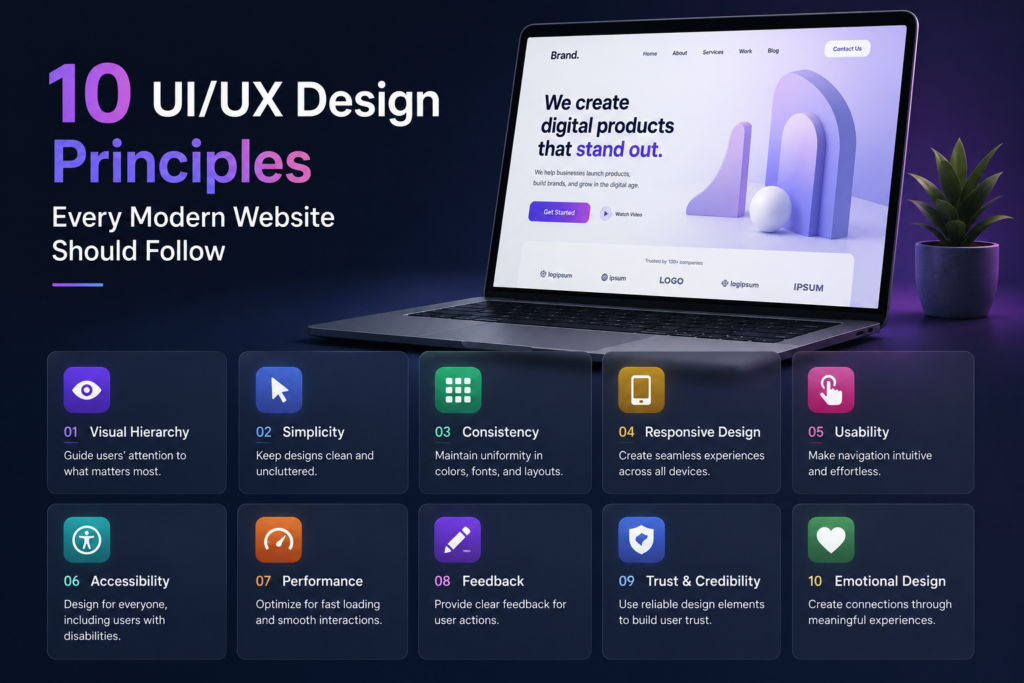
10 UI/UX Design Principles Every Modern Website Should Follow
Great design is invisible — it just works. Visitors arrive, find what they need, take action, and leave satisfied without ever stopping to admire the interface. That kind of effortless experience isn’t an accident. It’s the result of consistent application of proven design principles refined over decades.
Here are ten UI/UX design principles every modern website should follow in 2026.
1. Clarity Above All
Clarity is the most important principle in modern design. Visitors should immediately understand who you are, what you offer, and what to do next. The famous 10 Usability Heuristics by Nielsen Norman Group remain the gold standard for clarity-led design.
2. Consistency Builds Trust
Consistent typography, colours, spacing, and components signal professionalism. Inconsistency creates cognitive friction — even if visitors can’t articulate what feels off.
3. Visual Hierarchy Guides Attention
Strong design uses size, contrast, and spacing to guide the eye through a page in the right order. The most important element should always be the most visually dominant.
4. Speed Is a Design Decision
Performance is part of UX — not just engineering. Heavy images, unnecessary animations, and bloated pages destroy user experience. Google’s Core Web Vitals directly link speed to user satisfaction and rankings.
5. Mobile-First, Always
Most users now experience the web on mobile. Designing mobile-first ensures small-screen experiences are excellent, then expanding gracefully to larger screens. We apply this approach across every project — from new websites to website redesigns.
6. Accessibility Is Non-Negotiable
Accessible design isn’t optional — it’s essential. Following WCAG accessibility guidelines ensures your site works for everyone, including users with visual, motor, or cognitive impairments. Accessibility also significantly improves SEO.
7. Reduce Cognitive Load
Every extra option, decision, or distraction adds friction. Strong design simplifies — making the right action obvious and the wrong actions less prominent.
8. Use Whitespace Generously
Whitespace isn’t empty space — it’s a design tool. Well-placed whitespace improves readability, draws attention, and gives the entire interface room to breathe.
9. Design for Conversion, Not Just Beauty
Beautiful designs that don’t convert miss the point. Every section, button, and word should ladder up to a clear goal — whether that’s a booking, sale, or sign-up. This is exactly why our landing pages and CRO service focuses on design that delivers measurable business results.
10. Test, Iterate, Improve
Design is never finished. Use heatmaps, session recordings, and A/B tests through tools like Hotjar and VWO to continuously refine the experience based on real user behaviour.
Frequently Asked Questions
How long does great UI/UX design take?
Typically 2–6 weeks for most business websites; longer for complex platforms.
Do I need separate UI and UX designers?
For small projects, no. For complex platforms, often yes.
Is design more important than development?
Neither — they’re equally critical and must work together.
Final Thoughts
These ten principles consistently separate great websites from mediocre ones. If you’d like a design partner who applies them rigorously, book a free consultation and let’s build something exceptional.