
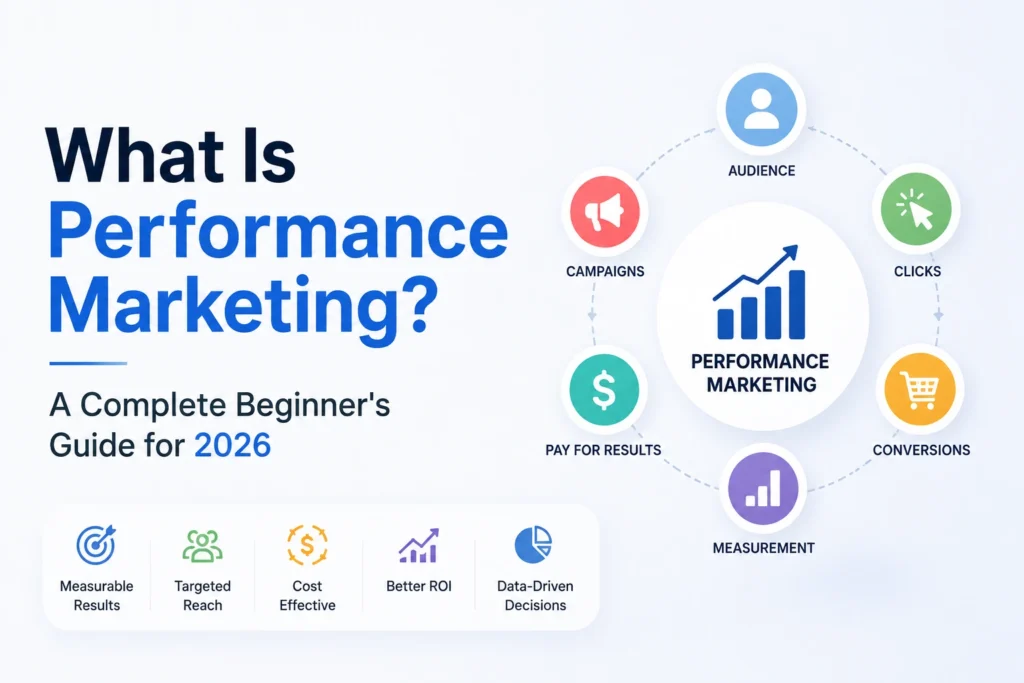
What Is Performance Marketing? A Complete Beginner’s Guide for 2026
Marketing budgets used to disappear into a black box. Brands spent, hoped, and waited months to find out whether anything worked. Performance marketing changed that completely. By tying every pound of spend to a measurable outcome — a click, a lead, a sale — performance marketing transformed advertising from a gamble into a system.
In this guide, we’ll explain exactly what performance marketing is, how it works, and why almost every modern growth business depends on it.
What Is Performance Marketing?
Performance marketing is a digital advertising approach where you only invest in marketing activities that deliver a measurable result. You track everything — impressions, clicks, conversions, cost per acquisition, return on ad spend — and continuously optimise based on real data, not assumptions.
In contrast to traditional brand advertising, performance marketing prioritises accountability. Every campaign is judged by its numbers.
How Performance Marketing Actually Works
A typical performance marketing campaign follows four stages: targeting the right audience, delivering the right creative, sending traffic to a high-converting landing page, and continuously optimising based on results. Platforms like Google Ads, Meta Ads, LinkedIn Ads, and TikTok Ads all use AI-driven systems to optimise delivery in real time — but only when fed strong creative and accurate conversion data.
This is the foundation of our performance marketing service.
Key Performance Marketing Metrics
Five core metrics define modern performance marketing. CPC (cost per click) tracks click cost. CPM (cost per thousand impressions) measures reach efficiency. CPA (cost per acquisition) tracks the cost of each new customer. ROAS (return on ad spend) measures revenue per ad pound. LTV (lifetime value) determines how profitable each customer is over time.
A great performance marketer doesn’t just lower CPA — they grow LTV, which is the real long-term metric.
Why Creative Matters More Than Ever
In 2026, ad platforms have become incredibly sophisticated at targeting. The differentiator is now creative — the headlines, visuals, and offers that actually stop the scroll. Strong creative is the single biggest lever in modern performance marketing, and brands that invest in it consistently outperform those who don’t. Research published by Meta’s own marketing science teams repeatedly shows that creative quality drives the majority of campaign variance.
Landing Pages Make or Break Campaigns
Even the best ad fails if it sends traffic to a weak page. High-converting landing pages are the secret weapon of profitable performance marketing — clear messaging, fast load speed, mobile-first design, and strong calls to action.
Attribution: The Hidden Backbone
Attribution determines which channels actually drive sales. Tools like Google Analytics 4 and platform-native tracking are critical for understanding what’s really working. Without proper attribution, performance marketing turns back into guesswork.
Frequently Asked Questions
Is performance marketing the same as PPC?
PPC is one part of performance marketing. The umbrella also includes social ads, affiliate, native, and influencer-based performance campaigns.
How much budget do I need to start?
Most brands begin meaningfully scaling between £500 and £5,000 per month, depending on goals and category.
How fast can I see results?
Often within days — though true optimisation takes weeks of testing.
Final Thoughts
Performance marketing turns advertising into an accountable, scalable growth engine. If you’re ready to build campaigns that pay for themselves, book a free consultation and let’s design a strategy together.