
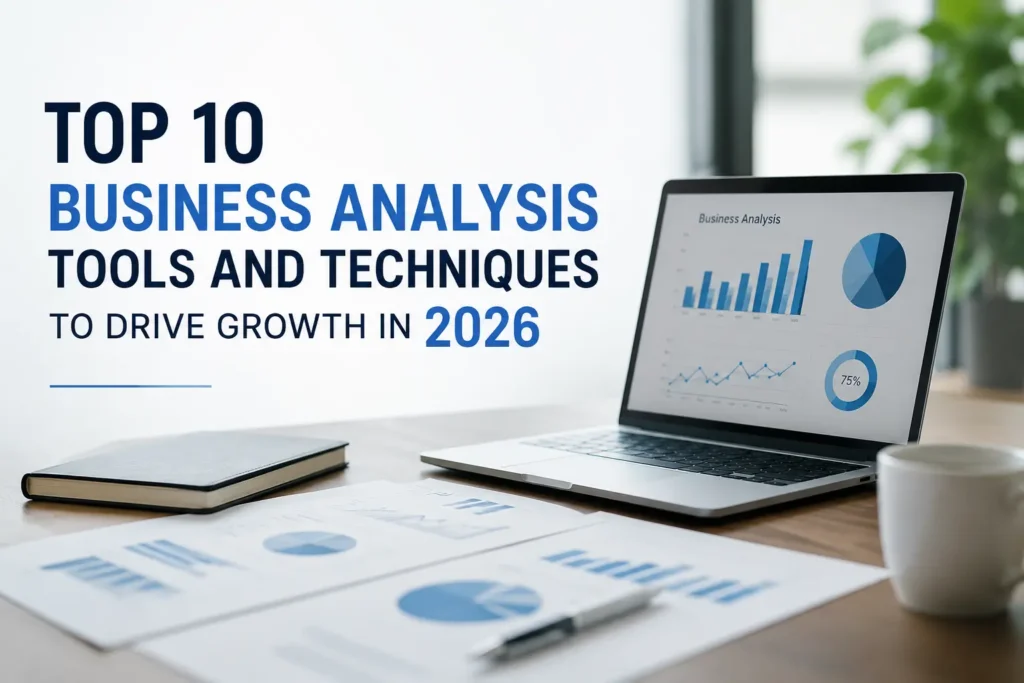
Top 10 Business Analysis Tools and Techniques to Drive Growth in 2026
Business analysis has evolved dramatically over the past few years. With the rise of AI-driven dashboards, automation platforms, and collaborative workspaces, today’s analysts have access to tools that would have seemed like science fiction a decade ago. But tools alone don’t deliver results — they need to be paired with the right techniques and a clear strategic intent.
In this guide, we’ll walk through ten of the most powerful business analysis tools and techniques used by modern companies to make smarter, faster, and more profitable decisions.
1. SWOT Analysis
SWOT remains one of the most foundational techniques in business analysis. It maps your Strengths, Weaknesses, Opportunities, and Threats, giving leadership a clear picture of where the business stands. Despite its simplicity, Harvard Business Review continues to highlight how strategic frameworks like SWOT remain central to high-stakes decision-making.
2. PESTLE Analysis
PESTLE — Political, Economic, Social, Technological, Legal, and Environmental — is essential when entering new markets. It surfaces external risks that internal analysis often misses, especially for businesses expanding across the UK, US, UAE, Canada, Australia, or India.
3. Microsoft Power BI
For data-heavy organisations, Microsoft Power BI has become the industry standard. It transforms raw data from multiple sources into interactive dashboards that anyone in your team can read — not just data scientists.
4. Tableau
Tableau is another visualisation powerhouse, especially loved for its drag-and-drop interface. Companies use it to track KPIs, customer journeys, and operational metrics in real time.
5. Lucidchart for Process Mapping
Process mapping is one of the most underrated techniques in business analysis. Tools like Lucidchart allow teams to visualise workflows, identify bottlenecks, and design improved processes — all crucial before any digital project begins.
6. Stakeholder Mapping
This technique identifies everyone who influences or is affected by a decision. Strong stakeholder mapping prevents costly surprises mid-project — a problem we frequently solve when redesigning websites or launching new digital products.
7. Requirement Gathering with Jira and Confluence
Atlassian’s Jira and Confluence remain dominant in modern requirement gathering — particularly for software and digital projects. Together, they keep documentation, tasks, and team conversations connected in one place.
8. Customer Journey Mapping
Mapping the actual journey customers take — from awareness to conversion — reveals where friction lives in your funnel. This insight directly fuels better UI/UX design and higher-converting landing pages.
9. Gap Analysis
Gap analysis compares your current state with your desired future state. It’s particularly valuable when planning a website redesign or evaluating digital maturity.
10. Google Analytics 4
For digital-first businesses, Google Analytics 4 remains essential. It connects your business analysis to real customer behaviour — clicks, conversions, drop-offs, and revenue paths.
Frequently Asked Questions
Which business analysis tool should I start with?
For most SMEs, starting with SWOT plus Google Analytics 4 covers 80% of early needs.
Are these tools expensive?
Many — including Lucidchart and Power BI — offer free or low-cost tiers suitable for startups.
Can I do business analysis without dedicated software?
Yes. Spreadsheets, whiteboards, and clear documentation can carry small teams a long way.
Final Thoughts
The best business analysis combines structured techniques with the right tools and — most importantly — a clear strategic question to answer. If you’re planning a digital project and want to make sure it’s grounded in real insight, our team can help you build a strategy that works.