
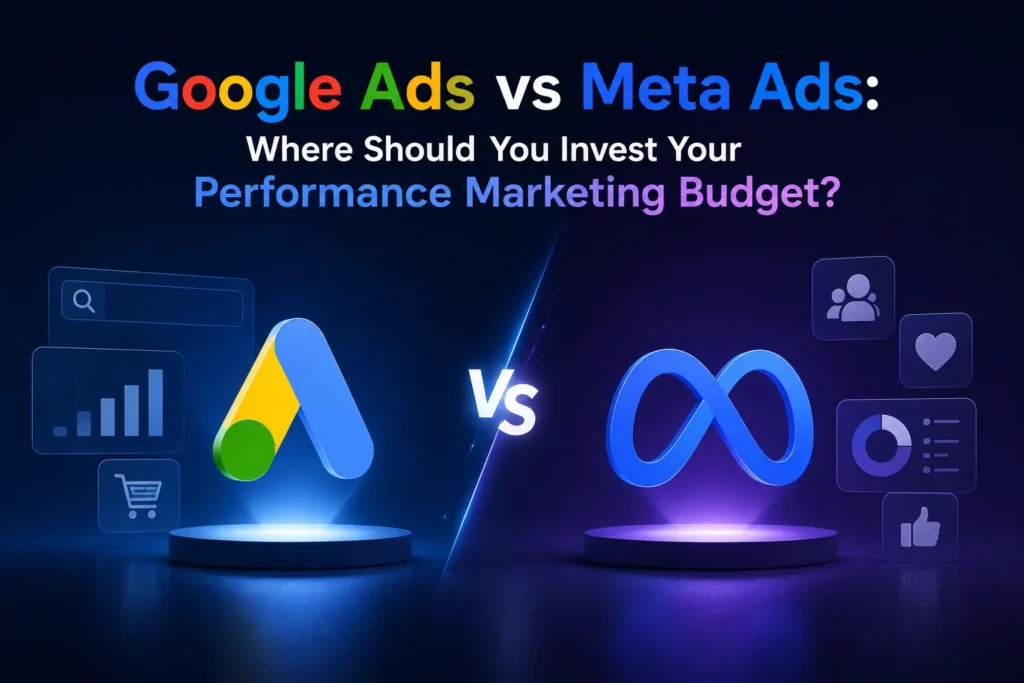
Google Ads vs Meta Ads: Where Should You Invest Your Performance Marketing Budget?
If you’re investing in paid advertising, two giants will dominate most of your budget conversations: Google Ads and Meta Ads. Both platforms can deliver exceptional ROI — but they work in fundamentally different ways. Choosing wrong can quietly burn thousands of pounds before you realise what’s happening.
In this guide, we’ll break down the real differences and help you decide where to invest first.
How Google Ads Works
Google Ads is built on intent. Users actively type queries — “best running shoes for marathons”, “emergency plumber near me”, “CRM for small business” — and your ads appear in front of buyers already showing purchase signals.
This makes Google Ads exceptionally powerful for capturing demand that already exists.
How Meta Ads Works
Meta Ads works differently. Users aren’t searching — they’re scrolling. Meta uses behavioural data to predict who’s likely to be interested in your offer, then surfaces your ad inside their feed at the right moment.
This makes Meta Ads exceptionally powerful for creating demand and reaching audiences who didn’t know they wanted you yet.
Intent vs Discovery
This is the core distinction. Google captures existing intent. Meta creates new interest. Both are valuable — but they suit different goals. Service businesses, B2B, and high-consideration purchases often start with Google. Lifestyle brands, e-commerce, and visually-driven products often start with Meta.
Creative Requirements
Google Ads relies primarily on copy. Strong headlines, sharp descriptions, and well-structured ad extensions drive performance. Meta Ads relies heavily on visual creative — videos, carousels, and scroll-stopping imagery. Creative requirements differ enormously, and brands often underestimate the production effort Meta requires. We integrate creative thinking directly into our performance marketing campaigns.
Targeting
Google’s strongest targeting is keyword-based — you reach people based on what they’re actively searching. Meta’s strongest targeting is interest, behaviour, and lookalike-based, plus increasingly powerful AI-driven audiences. Both have moved toward broader, AI-driven targeting models in recent years, supported by their ML infrastructure.
Costs
Google Ads tends to have higher cost-per-click but typically delivers higher-intent traffic. Meta Ads tends to have lower CPCs but requires more volume to generate equivalent conversions. Industry data from WordStream regularly compares benchmarks across industries.
Which Should You Start With?
If your audience is actively searching for what you sell — start with Google. If your audience needs to discover what you sell — start with Meta. Most mature performance strategies eventually run both, but the right starting point depends entirely on intent levels in your category.
We help businesses across all our served industries make this exact call as part of strategy planning.
Frequently Asked Questions
Can I run both at the same time?
Yes — and most growth-stage brands eventually do.
Which is cheaper?
It depends entirely on industry, audience, and creative.
Which has better ROI?
Both can be exceptional. The platform isn’t the differentiator — strategy is.
Final Thoughts
Google Ads and Meta Ads are both world-class platforms. The right one for you depends on intent, audience, and stage. If you’d like a tailored recommendation, contact our team and we’ll guide your next move.