
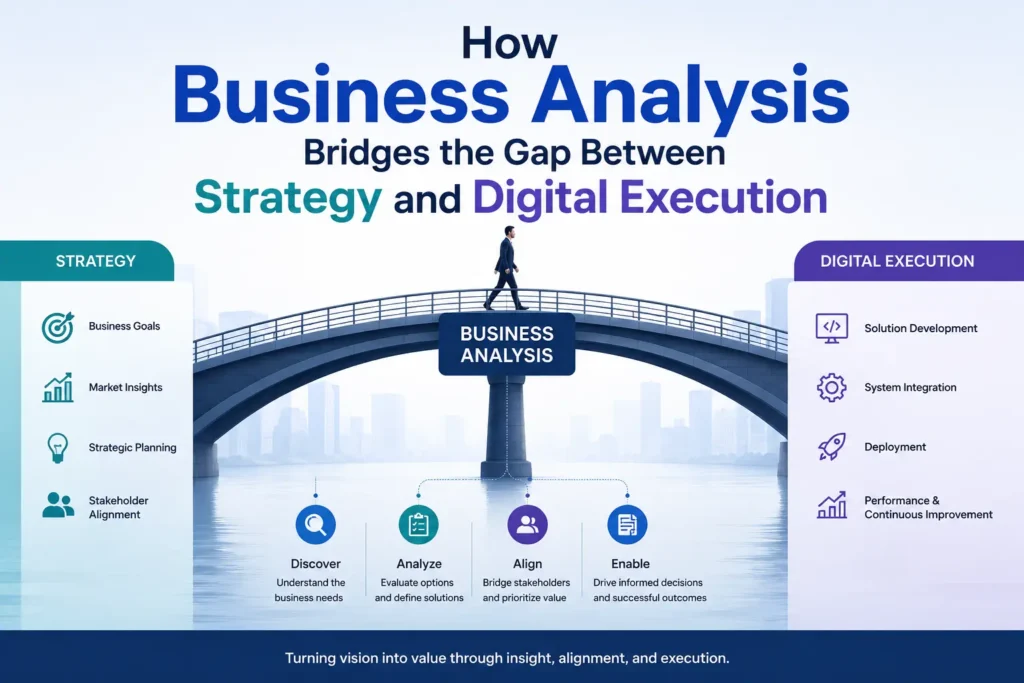
How Business Analysis Bridges the Gap Between Strategy and Digital Execution
Most businesses don’t fail because of bad strategy. They fail because their strategy never makes it intact through the messy process of execution. Vision documents become PowerPoint decks. PowerPoint decks become vague briefs. Vague briefs become disappointing websites, marketing campaigns, and product launches that never deliver what leadership originally imagined.
Business analysis is the discipline that prevents this drift. It’s the connective tissue between what leaders want, what teams build, and what customers experience.
The Strategy-Execution Gap (And Why It Costs You Money)
Research from consulting firms like Deloitte consistently shows that a significant proportion of strategic initiatives underperform — not because the strategy was wrong, but because execution didn’t match intent. The cost is enormous: wasted budgets, missed market windows, and disengaged teams.
Business analysis closes this gap by translating strategic ambition into specific, measurable, and testable requirements that designers, developers, marketers, and operators can act on with clarity.
How Business Analysis Translates Strategy Into Digital Reality
When done well, business analysis breaks high-level goals into structured layers. A goal like “grow online revenue by 30%” becomes a set of business objectives, measurable KPIs, customer journey requirements, technical specifications, and content strategies. Each layer feeds the next — and crucially, each layer can be tested.
This is why we begin every Syvera Digital project with a discovery phase. Before we touch a Figma file or write a line of code, we map your goals, audience, competitors, and current digital maturity. You can see exactly how this works inside our process.
Where Analysis Meets Execution: Practical Examples
For a website redesign, analysis identifies which pages convert, which leak traffic, and which user journeys are broken. For performance marketing, it defines who your most profitable customers really are — not who you think they are. For SEO, it uncovers the real keywords your audience uses and the content gaps your competitors leave open.
In each case, the technical work becomes faster and more accurate because the strategic foundation is solid. Tools like SEMrush and Ahrefs become genuinely powerful only when guided by clear analytical intent.
Why This Matters Even More in the AI Era
With AI accelerating both opportunity and noise, businesses that lack structured analysis will increasingly waste resources experimenting in the dark. Analysis-first companies, by contrast, use AI as a force multiplier — testing, learning, and scaling much faster than their competitors.
Frequently Asked Questions
Is business analysis the same as project management?
No. Project management focuses on delivering on time and on budget. Business analysis focuses on whether you’re building the right thing in the first place.
How long should the analysis phase take?
For SMEs, even a focused 1–2 week discovery can transform project outcomes.
Do agencies usually offer business analysis?
The strong ones do. We embed it directly into every Syvera Digital engagement.
Final Thoughts
If you’ve ever launched a website or campaign that underperformed, the answer probably wasn’t more design or more ads. It was more clarity at the start. Talk to our team and let’s bridge your strategy and execution properly.